Process models in software engineering
Five software process models compared: waterfall, iterative, spiral, V-model and big bang, with when each one fits.
3 min readUpdated
A software development life cycle (SDLC) is the structured sequence of stages a team goes through to build a software product: typically requirements, analysis, design, coding, testing, deployment and maintenance. A process model decides how those stages are ordered and repeated. This note describes five classic models, how each works and where it fits.
Waterfall model
The waterfall model is the simplest process model. The SDLC phases run one after another in a straight line: requirement gathering, system analysis, coding, testing, implementation, and operations and maintenance. A phase starts only when the previous one is finished, as the diagram shows.
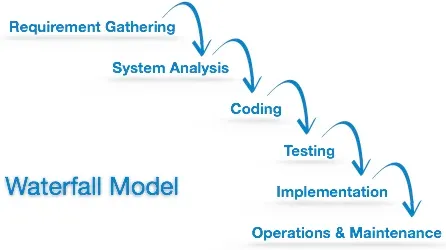
The model assumes each phase is completed correctly as planned, so no earlier issue comes back in a later phase. It copes badly when problems are left over from a previous step, because its sequential nature does not allow going back to undo or redo work.
Waterfall suits teams that have built similar software before and know the domain well, so the requirements are stable from the start.
Iterative model
The iterative model develops software in cycles. Each iteration repeats design, coding, testing and verification, as in the diagram, and the output of one iteration feeds the next.
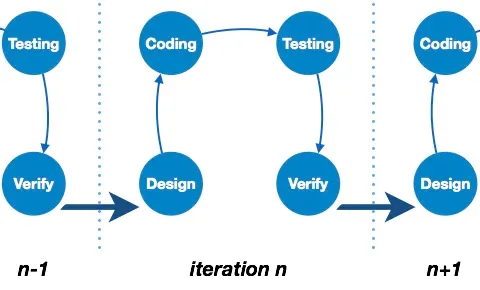
Development starts with a very small part of the system that goes through all the steps. Each following iteration designs, codes, tests and adds more features and modules. Every cycle produces working software that is complete in itself and does more than the previous version.
After each iteration, management can review risks and plan the next one. Because each cycle covers only a small part of the whole system, the process is easier to manage, but it takes more resources overall.
Spiral model
The spiral model, introduced by Barry Boehm, combines the iterative model with the phases of a sequential model and puts risk analysis at the centre. The project goes round the spiral several times; each turn passes through four quadrants, and the cumulative cost grows with every turn.
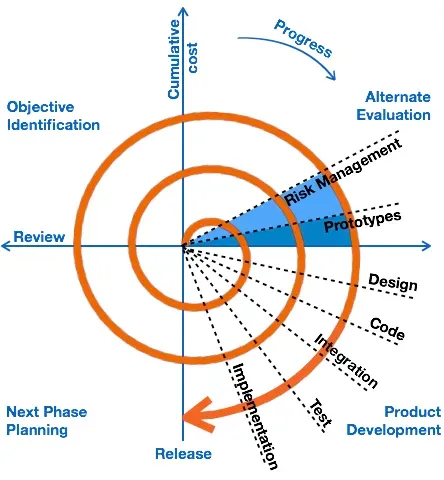
- Objective identification: determine the objectives, alternatives and constraints for this iteration.
- Alternative evaluation: analyse the risks and build prototypes to reduce them.
- Product development: design, code, integrate and test using a standard sequential model.
- Next phase planning: review the result and plan the next iteration.
The explicit risk step is what sets the spiral model apart: most other models leave risk unaddressed.
V-model
The main drawback of the waterfall model is that you move to the next stage only when the previous one is finished, with no way back if a later stage finds something wrong. The V-model pairs every development stage with a test stage, so testing is planned from the start. The left side of the V goes down through the development stages (verification); the right side goes up through the matching test stages (validation), as the diagram shows:
| Development stage | Test stage |
|---|---|
| Requirement gathering | Acceptance testing |
| System analysis | System testing |
| Software design | Integration testing |
| Module design | Unit testing |
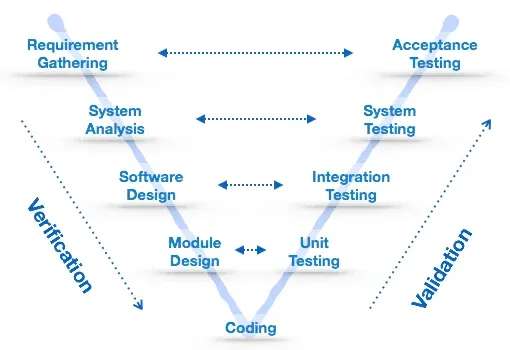
At each stage, test plans and test cases are written to check the product against that stage’s requirements. For example, during requirement gathering the test team prepares the acceptance test cases. Later, when the product is built and ready for testing, those test cases check the software against the requirements.
Verification and validation thus run in parallel, which is why the V-model is also called the verification and validation model.
Big bang model
The big bang model needs very little planning. It follows no particular process: time, effort and resources go in, and software comes out. Often the customer is not sure about the requirements and future needs, so the input requirements are arbitrary.
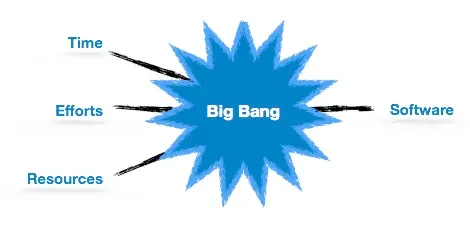
The model is not suitable for large projects, but it works for learning, experiments and very small projects.